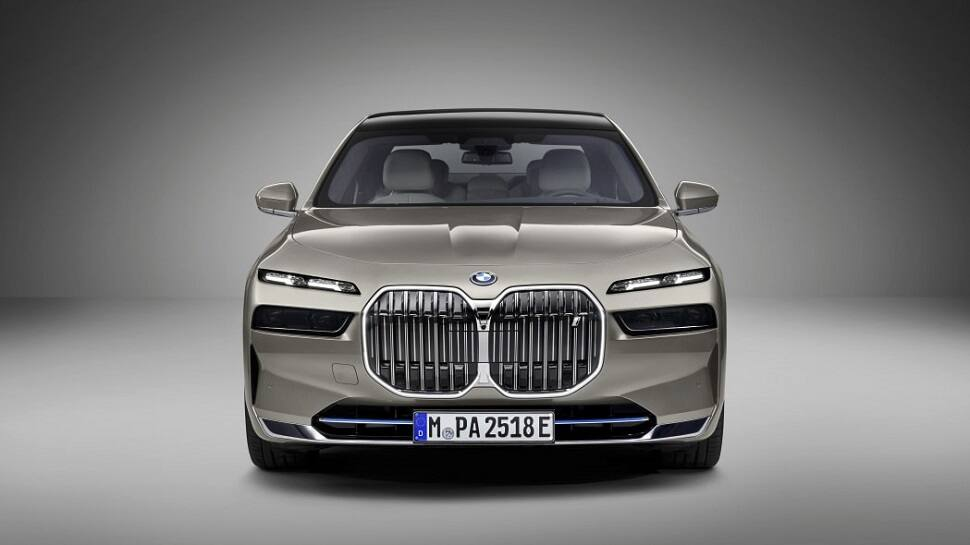
BMW has introduced the refreshed 7 Series, its premier luxury sedan. This mid-cycle enhancement features exterior modifications, a comprehensive interior overhaul, and technology derived from the forthcoming Neue Klasse series. The model will be offered in petrol, diesel, plug-in hybrid, and electric variants. Below are all the specifics regarding this latest version of the competitor to the Mercedes-Benz S-Class.
BMW 7 Series Facelift: Exterior Modifications
The 7 Series maintains its dimensions while receiving updated styling at both the front and rear. The headlights now incorporate slender daytime running lights positioned above the vertical main units, along with a redesigned bumper and hood. The kidney grille has transitioned to horizontal slats rather than vertical ones. At the back, the tail-lights have been slimmed down and feature a new design with a blacked-out lower section. The side profiles are more streamlined with fewer creases. This is all enhanced by alloy wheels that can reach up to 22 inches, along with a variety of paint options, including dual-finish designs.
BMW 7 Series Facelift: Interior and Features
The interior experiences the most significant transformation, featuring a new dashboard configuration for the Panoramic iDrive on Operating System X. This setup includes a full-width display integrated into the windscreen, a 17.9-inch central touchscreen, and a standard 14.6-inch screen for passengers. It supports AI voice control, over-the-air updates, and smartphone connectivity.
Inside, there is a vertical twin-spoke steering wheel, a crystal gear selector, and fewer physical buttons. Rear passengers are treated to a 31.3-inch 8K Theatre Screen equipped with Dolby Atmos, video calling capabilities, and gaming options. Touch controls located in the rear doors allow for screen position adjustments. The interior is completed with ambient lighting, a panoramic roof, and a four-zone climate control system.
BMW 7 Series Facelift: Powertrain
ICE Options: The refreshed BMW 7 Series introduces a variety of powertrain choices, including petrol, diesel, plug-in hybrid, and fully electric variants. Beginning with the 3.0-litre in-line six-cylinder petrol and diesel engines, these configurations are complemented by a 48V mild-hybrid system. In the 740 xDrive, the petrol engine delivers 400 hp and 580 Nm of torque, while the 740d xDrive diesel engine produces 313 hp and 670 Nm.
Plug-in Hybrid: The plug-in hybrid lineup includes the 750e xDrive and M760e xDrive, both of which are equipped with a 3.0-litre inline-six petrol engine in conjunction with an electric motor. The 750e generates 489 hp and 700 Nm of torque, whereas the M760e offers 612 hp and 800 Nm. The estimated electric-only range for the 750e is between 70-82 km, while the M760e has an approximate range of 80 km, as per WLTP standards.
Electric Powertrain: The fully electric i7 series presents several variants, including the i7 50 xDrive, i7 60 xDrive, and i7 M70 xDrive. Each model is fitted with a battery capacity of around 112.5 kWh and supports DC fast charging at rates up to 250 kW. Power outputs range from 455 hp and 660 Nm in the i7 50 xDrive to 680 hp and a peak torque of 1100 Nm in the i7 M70 xDrive. The claimed WLTP range is estimated to be between 566 km and 728 km, depending on the specific variant.
BMW 7 Series Facelift: India Launch
The launch of the BMW 7 Series Facelift in India is anticipated to occur in late 2026 or early 2027, with production of the flagship sedan set to commence in July 2026.