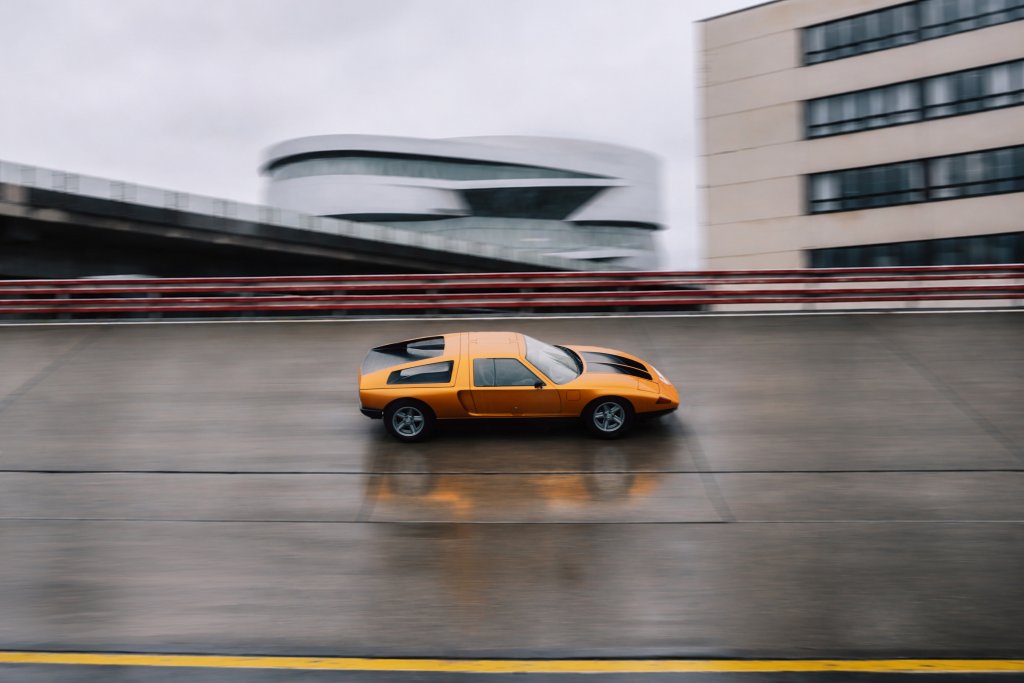
The automotive world has always been fascinated by rare concept cars, experimental engineering, and vehicles that represent important moments in automotive history. Among the most remarkable examples is the Mercedes-Benz C111-II, an extraordinary experimental sports car that helped demonstrate the German manufacturer’s engineering ambitions during the early 1970s.
With its futuristic design, distinctive gullwing doors, powerful rotary engine technology, and advanced aerodynamic features, the C111-II remains one of the most memorable experimental vehicles ever developed by Mercedes-Benz. Its appearance in a Paris auction brings renewed attention to a remarkable chapter in the history of automotive innovation.
Unlike ordinary production vehicles, the C111-II was created primarily as a technology demonstrator. It allowed Mercedes-Benz engineers to experiment with new materials, alternative engine configurations, aerodynamics, and high-performance technologies.
For classic car enthusiasts and collectors, its auction appearance represents an opportunity to appreciate a vehicle that is much more than an attractive vintage sports car. It is a symbol of an era when automakers were exploring bold ideas about the future of driving.
1. A Historic First for Mercedes-Benz
The upcoming auction is particularly significant because Mercedes-Benz has never previously offered a C 111 prototype for public sale.
The car selected for the auction is a 1970 Mercedes-Benz C 111-II, internally identified as Car 33. It has remained part of the manufacturer’s collection for decades and was previously displayed at the Mercedes-Benz Museum in Stuttgart.
Only 17 C 111 prototypes were built, and 13 survive today, all of which have remained in Mercedes-Benz ownership. This makes the decision to release one of these vehicles an extraordinary moment for collectors.
Mercedes-Benz has also committed not to sell another C 111 for at least 25 years, making this opportunity particularly unusual.
2. Auction Details: When and Where Will It Be Sold?
The Mercedes-Benz C 111-II will be offered through RM Sotheby’s at the Palais du Louvre in Paris.
Here are the important auction details:
-
Auction date: February 3, 2027
-
Location: Salles du Carrousel, Palais du Louvre, Paris, France
-
Auction house: RM Sotheby’s
-
Event: The Paris Auction during Rétromobile
-
Estimated value: More than €25 million
Interested collectors must register in advance. Bidding will be available in person or by telephone, but internet bidding will not be permitted for this particular vehicle.
The auction is expected to attract considerable international attention because of the car’s historical importance and extraordinary rarity.
3. Mercedes-Benz C 111-II: A Revolutionary Design
The Mercedes-Benz C 111-II was introduced at the Geneva Motor Show in March 1970. Its appearance was dramatically different from conventional sports cars of that period.
The vehicle featured a low-slung body, distinctive gullwing doors, a streamlined front section, and an aerodynamic rear design. Its striking Weißherbst orange paintwork made it instantly recognisable.
The car was designed with a focus on aerodynamics and engineering experimentation. Compared with the earlier C 111, the second-generation version featured improved visibility and aerodynamic refinements.
Its body was constructed using glass-fibre-reinforced plastic mounted on a steel underbody structure.
The C 111-II was approximately 1,120 millimetres tall, giving it an extremely low and futuristic appearance.
Even today, its styling looks remarkably modern and demonstrates how ambitious automotive design was becoming during the 1970s.
4. Four-Rotor Wankel Engine: The Biggest Attraction
One of the most fascinating aspects of the C 111-II is its unusual powertrain.
Unlike conventional piston engines, this experimental sports car uses a four-rotor Wankel rotary engine. The 2.4-litre M 950 engine was developed to explore the performance potential of rotary technology.
Its specifications include:
-
Engine: 2.4-litre four-rotor Wankel
-
Power output: Approximately 350 hp (257 kW)
-
Maximum engine speed: 9,000 rpm redline
-
Transmission: Five-speed ZF gearbox
-
Drivetrain: Rear-wheel drive
-
Engine placement: Mid-mounted
The rotary engine was one of the most ambitious engineering experiments of its time. Its compact construction and high-revving characteristics made it particularly interesting for high-performance applications.
The C 111-II demonstrated that Mercedes-Benz was willing to explore alternatives to traditional engine technology in pursuit of improved performance and engineering innovation.
5. Impressive Performance for a 1970 Sports Car
Despite being an experimental vehicle, the C 111-II delivered impressive performance figures.
According to the auction specifications, the car can accelerate from 0 to 100 km/h in approximately 4.8 seconds and reach a claimed top speed of 300 km/h.
For a vehicle developed more than five decades ago, these figures remain remarkable.
Its relatively low weight of approximately 1,240 kilograms also contributed to its performance.
The combination of a mid-mounted engine, rear-wheel drive, lightweight construction, and aerodynamic bodywork helped create an extraordinary driving machine.
These characteristics explain why the C 111-II continues to attract attention from automotive historians and performance-car enthusiasts.
6. The Fascinating History of Car 33
The specific vehicle heading to auction has an interesting history.
Car 33 was the third example of the C 111-II development stage. Mercedes-Benz used it for several engineering and testing activities during the 1970s.
It participated in evaluations of the rotary engine, including testing at the Hockenheimring. The vehicle was also used in an unusual luggage-compartment temperature experiment known as the butter test.
In 1971, the car was demonstrated to renowned conductor Herbert von Karajan. It also appeared in the first German edition of Playboy magazine in 1972.
The vehicle eventually became part of the Mercedes-Benz collection and was displayed in the Fascination of Design exhibition at the Mercedes-Benz Museum from 2006.
In 2024, it underwent recommissioning work at the Mercedes-Benz Classic Center before appearing at the Pebble Beach Concours d’Elegance.
As of October 2026, its odometer showed 24,766 kilometres.
7. Original Condition and Included Accessories
Another important attraction for collectors is the car’s preserved condition.
Rather than receiving a complete cosmetic restoration, the vehicle retains its original paintwork and interior, including the distinctive grey-and-white houndstooth upholstery.
The auction also includes additional equipment and accessories.
These include its road wheels, a separate set of magnesium wheels with racing tyres, and a removable rear luggage compartment tray.
The magnesium wheels are intended for display rather than regular road use.
Such original components and historical details can make a significant difference when evaluating a rare collector vehicle.
8. Why Is Mercedes-Benz Selling This Rare Car?
The decision to auction the C 111-II is connected to the future development of the Mercedes-Benz Museum in Stuttgart, Germany.
Mercedes-Benz has announced that the proceeds will support its museum development project, including plans to improve the museum’s digital accessibility.
One important ambition is to create a digital twin that will allow people worldwide to explore the museum’s collection digitally.
This initiative could make important vehicles, historical documents, and automotive innovations accessible to people who cannot physically visit Stuttgart.
The auction therefore has a purpose beyond transferring ownership of a rare automobile. It will also help support the preservation and presentation of Mercedes-Benz automotive heritage.
9. Could the Mercedes-Benz C 111-II Become a Record-Breaking Auction Car?
With an estimated value exceeding €25 million, the C 111-II is expected to become one of the most expensive experimental Mercedes-Benz vehicles ever offered publicly.
The auction also brings back memories of the famous 1955 Mercedes-Benz 300 SLR Uhlenhaut Coupé, which sold for €135 million in 2022 through RM Sotheby’s.
Although the two vehicles have different historical significance and market positions, the previous sale demonstrates the extraordinary prices that exceptionally rare Mercedes-Benz automobiles can achieve.
The C 111-II has an additional advantage: it is the first example of the C 111 family to become available to private collectors.
Its rarity, engineering history, originality, and connection to the Mercedes-Benz Museum could make it particularly desirable among serious collectors. However, its final selling price will depend on bidding interest on auction day.
10. Why This Auction Matters to Automotive Enthusiasts
The upcoming sale is important because it highlights a vehicle that represents a different direction in automotive engineering.
During the late 1960s and early 1970s, manufacturers were experimenting with unconventional engines, lightweight materials, aerodynamic shapes, and new performance technologies.
The C 111-II captured many of these ambitions in a single vehicle.
Although it never entered mass production, its experimental development contributed to the wider history of automotive research. The C 111 programme also influenced subsequent Mercedes-Benz high-speed experimental and record-breaking vehicles.
For enthusiasts, the auction offers an opportunity to revisit an era when manufacturers were willing to challenge traditional engineering ideas.
Conclusion
The Mercedes-Benz C 111-II heading to auction in Paris is much more than a rare vintage sports car. It represents an important chapter in the history of automotive innovation, combining futuristic styling, experimental rotary-engine technology, and impressive performance.
Scheduled for February 3, 2027, at the Palais du Louvre, the RM Sotheby’s auction will mark the first time Mercedes-Benz has offered a C 111 prototype for public sale.
With an estimated value exceeding €25 million, the vehicle is expected to attract considerable attention from international collectors.
Beyond its potential auction value, the sale will also support the future development of the Mercedes-Benz Museum, helping preserve automotive history for future generations.