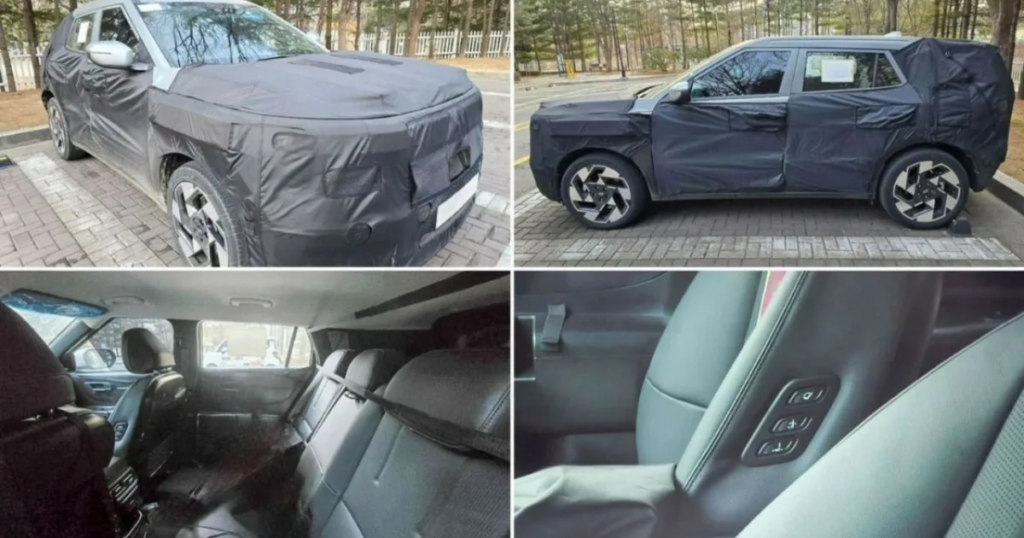
New spy images of the third-generation Hyundai Creta, set to launch in 2027, have emerged online, showcasing its interior for the first time. The midsize SUV was observed undergoing tests just two weeks ago, but its interior details were not visible at that time.
- The new Creta may feature an ottoman for the front passenger seat.
- It is likely to have redesigned upholstery and door trims.
Details of the 2027 Hyundai Creta so far
One of the most notable features seen in the interior spy images is the inclusion of a zero-gravity button similar to that found in the Hyundai Ioniq 5. In the electric vehicle, this feature allows the passenger seat backrest to recline while extending an ottoman for enhanced comfort. The current Creta does provide a Boss mode that adjusts the position and recline angle of the front passenger seat in the top-tier King and King Knight variants, but it does not include an ottoman. It remains uncertain whether Hyundai will incorporate this additional comfort feature in the India-specific model.
The spy images also showcase a new upholstery design and updated door trims. Notably, the test vehicle did not come equipped with a sunroof.
The latest test vehicle, similar to the previously seen one, was heavily camouflaged. However, this time, the larger 19-inch alloy wheels with a distinctive geometric pattern are prominent, replacing the previous model’s 18-inch wheels. These larger wheels are expected to give the SUV a sportier appearance, but it is still uncertain if Hyundai will offer them in this market. If they do, the key consideration will be ride comfort, particularly on local roads. If available, they are likely to be limited to higher-end variants and the N-Line models. For context, the current Creta is available with wheel sizes ranging from 16 to 18 inches.
2027 Hyundai Creta platform and powertrains
Similar to the newly introduced Kia Seltos, the upcoming Creta is expected to transition to the more advanced and safer K3 platform. Should this occur, the engine choices are anticipated to remain consistent with those of the existing model: a 115hp 1.5-litre naturally aspirated petrol engine, a 116hp 1.5-litre diesel engine, and a 160hp 1.5-litre turbo-petrol engine. All three powertrains are expected to be paired with a standard 6-speed manual transmission. The naturally aspirated petrol variant may continue to provide a continuously variable transmission (CVT), while the diesel variant could feature a 6-speed torque converter automatic transmission, and the turbo-petrol variant might be equipped with a 7-speed dual-clutch transmission. The transition to the K3 platform may also pave the way for a hybrid variant utilizing the 1.5-litre naturally aspirated petrol engine.