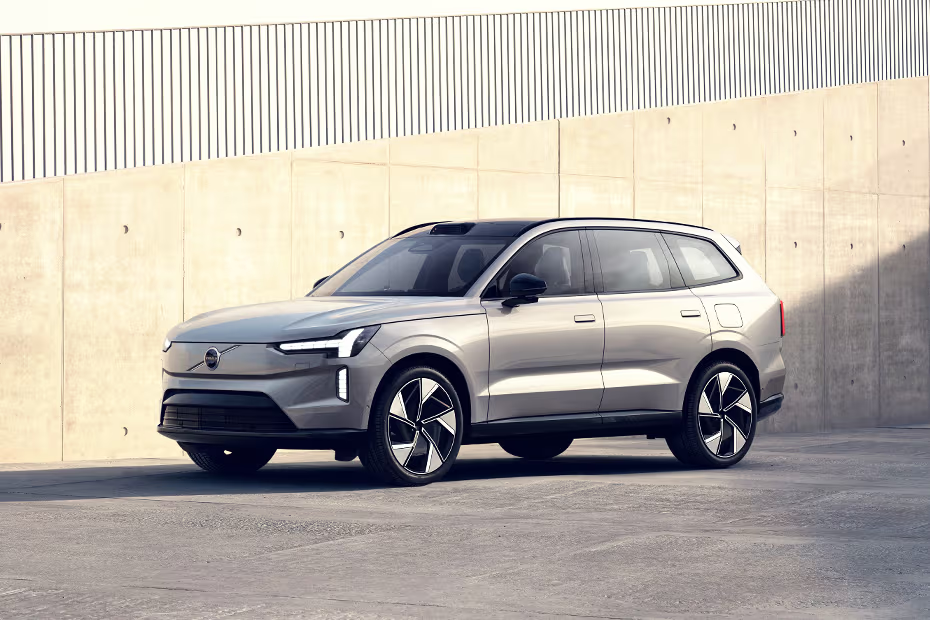
The Volvo EX90 represents one of the biggest changes in Volvo’s modern history. It is not simply another electric vehicle added to the Swedish automaker’s lineup. Instead, the EX90 is designed to demonstrate what Volvo believes its next generation of cars should look and feel like: fully electric, highly connected, exceptionally safe, spacious, and increasingly software-driven.
After spending time behind the wheel, one thing becomes clear: the EX90 is an impressive and ambitious SUV. But ambition also brings compromises. While it delivers refinement, comfort and impressive technology, its size, complexity and evolving software raise an important question—has Volvo taken the right path into the future?
A Bold New Design
Volvo has never been a company that relies heavily on flashy styling, and the EX90 follows that philosophy. Its design is clean, restrained and unmistakably Scandinavian.
The front end is dominated by a smooth, closed-off grille area, while the familiar Thor’s Hammer lighting signature gives the SUV a recognizable identity. The body is large, but Volvo has managed to keep the overall appearance relatively elegant rather than making it look unnecessarily aggressive.
The EX90’s aerodynamic shape is also important. With electric vehicles, reducing air resistance can make a meaningful difference to efficiency and driving range. Volvo has therefore blended traditional SUV proportions with smoother surfaces and carefully shaped details.
It may not turn heads in the same way as some luxury electric SUVs, but that is arguably the point. The EX90 feels mature rather than attention-seeking.
A Quiet and Comfortable Cabin
Step inside, and the EX90 feels like a significant departure from many traditional Volvo models. The interior is minimalist, with a large central touchscreen taking care of many vehicle functions.
The materials and overall presentation are exactly what you would expect from Volvo. There is a strong emphasis on sustainable materials, simple shapes and a calm atmosphere. Rather than surrounding occupants with dozens of buttons, the cabin attempts to create a clean and uncluttered environment.
The biggest advantage is comfort. The seats are excellent, and the quietness of the electric powertrain makes long journeys particularly relaxing. Road and wind noise are kept impressively low, giving the EX90 the kind of serene character that suits a premium family SUV.
Plenty of Space for Families
One of the EX90’s strongest arguments is practicality. This is a genuine three-row SUV, meaning it is designed to carry larger families rather than simply offering occasional rear seats.
The first two rows provide generous space, while the third row is more usable than in many seven-seat SUVs. Access is reasonably straightforward, although adults will naturally find the rearmost seats less spacious than the front two rows.
Cargo capacity is also useful, although carrying seven people naturally reduces luggage space. Fold the rear seats down, however, and the EX90 becomes a highly practical vehicle for everyday family duties.
Performance: More Relaxed Than Sporty
The EX90 is not intended to be a sports SUV, and that becomes obvious quickly. Depending on the powertrain, it can deliver substantial performance, but its character is primarily about smoothness and confidence.
Acceleration is strong, particularly from higher-output versions, but Volvo has avoided making the car feel unnecessarily dramatic. Power delivery is linear and predictable, which makes the EX90 easy to drive in urban traffic and on highways.
The steering is similarly composed rather than overly communicative. This is a vehicle designed to make journeys effortless, not to encourage aggressive cornering.
Its considerable size and weight are noticeable, particularly on narrower roads. Nevertheless, the EX90 generally feels controlled and stable.
The Technology Is Impressive—and Complicated
Technology is perhaps the most interesting aspect of the EX90. Volvo has built the vehicle around a new software architecture, allowing many functions to be controlled and updated digitally.
The large infotainment display provides access to navigation, climate controls, media and vehicle settings. Smartphone integration and connected features further strengthen the feeling that the EX90 is more like a sophisticated computer on wheels than a conventional SUV.
There is also extensive driver-assistance technology, supported by an array of sensors designed to improve awareness and safety.
However, this approach has a downside. Moving so many controls into a touchscreen can sometimes make simple tasks less intuitive than physical buttons. Furthermore, software-heavy vehicles can experience glitches or require updates in ways that traditional cars do not.
That means the EX90’s technology is both one of its greatest strengths and one of its biggest uncertainties.
Safety Remains at the Heart of Volvo
For decades, Volvo has built its reputation around safety, and the EX90 takes that responsibility seriously.
Its sensor technology and driver-assistance systems are designed to help detect potential hazards and support the driver. The vehicle is also engineered around occupant protection, continuing Volvo’s long-standing focus on preventing and reducing the consequences of crashes.
What makes the EX90 particularly interesting is how Volvo is combining traditional passive safety with increasingly sophisticated active systems. The goal is not simply to protect occupants after an accident but to help avoid dangerous situations in the first place.
Is the Volvo EX90 the Right Direction?
The answer depends heavily on what you expect from a luxury SUV.
If you want a quiet, spacious and comfortable electric vehicle with advanced technology, strong safety credentials and understated styling, the EX90 makes a compelling case. It feels premium without being excessive and futuristic without abandoning Volvo’s traditional sense of restraint.
But buyers who prefer physical controls, simpler technology or a more engaging driving experience may find the EX90 less convincing. Its size can also be challenging in tight urban environments, and its software-centered approach represents a learning curve for drivers accustomed to conventional cars.
Final Verdict
The Volvo EX90 is undoubtedly a major step for the brand. It combines Volvo’s traditional strengths—safety, comfort, practicality and understated design—with an entirely new electric and software-driven philosophy.
It isn’t perfect, and some of its technology-first decisions may take time to mature. Yet that is also what makes the EX90 significant. Volvo is clearly attempting to redefine its flagship SUV rather than simply electrifying an existing formula.
For families looking for a refined, high-tech electric SUV, the EX90 deserves serious consideration. It may not be the most exciting EV on the road, but it could be one of the most comfortable and thoughtfully designed.
So, is it the right chapter for Volvo? Probably—but it is a chapter that will ultimately be judged not just by how impressive the technology is today, but by how seamlessly that technology improves the ownership experience over the years.