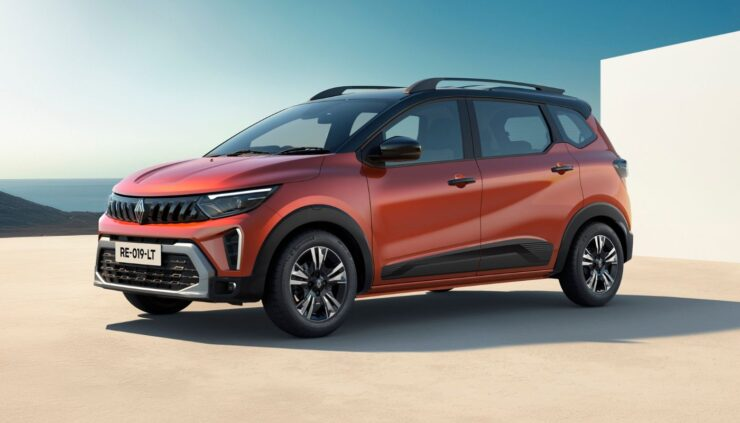
I’ll admit it: I was never convinced the Renault Triber needed a turbo-petrol engine.
The Triber was designed around a fairly simple idea — offer buyers a compact, practical and affordable seven-seater that could handle everyday family duties without demanding too much road space. It was never supposed to be quick, sporty or particularly exciting.
And, for the most part, the naturally aspirated 1.0-litre three-cylinder petrol engine did the job. Around town, it was easy enough to drive, the AMT made life convenient, and the Triber’s compact dimensions made it remarkably usable as a family car. Highway performance was its obvious weak point, but that seemed like a reasonable compromise for what the Triber was trying to be.
Now, Renault has given it a turbocharged petrol engine borrowed from the Kiger — although not quite in the form you might expect.
After driving the new Triber Turbo, I’ve had to reconsider my original opinion.
Renault Triber Turbo: What’s New?
The new Triber gets a 1.0-litre three-cylinder turbo-petrol engine producing around 99 bhp and 180 Nm. Interestingly, Renault says this isn’t simply the Kiger Turbo engine dropped into the Triber. It has been recalibrated specifically for the MPV, and its 180 Nm torque output is actually 20 Nm more than the Kiger Turbo produces.
Getting the turbo engine into the Triber also required more than simply changing the engine.
The older CMF-A platform didn’t have the necessary packaging or engineering headroom for the turbocharged powertrain. As a result, the Triber has moved to Renault’s newer RGEP, or Renault Group Entry Platform.
There are several other mechanical changes too. Since a turbocharged engine produces more heat, Renault has fitted a BLDC fan to the radiator and condenser assembly. The body structure has also been strengthened up to the C-pillar, while anti-roll bars have been added to improve stability.
All of those changes come at a cost: the Turbo is roughly 80 kg heavier than the naturally aspirated Triber.
That sounds like a lot of engineering effort for a car that was never supposed to be fast. But once you’re behind the wheel, the reasoning becomes clearer.
Performance: Where the Turbo Makes a Difference
The first thing you notice isn’t actually the extra power. It’s the refinement.
The three-cylinder engine feels smoother than the naturally aspirated unit, although the familiar character of the Triber remains. Pulling away from a standstill isn’t particularly dramatic, and the first couple of gears are quite short.
In slow-moving traffic, therefore, the Turbo doesn’t immediately feel like a completely different car.
Keep the revs low and shift early, and it remains a relaxed, easy-going family car. The real change arrives once the engine crosses roughly 2,000 rpm and the turbo starts doing its thing.
That’s when the Triber develops a much stronger mid-range.
Instead of gradually building speed and requiring plenty of patience, the Turbo pulls with considerably more enthusiasm. The difference isn’t especially dramatic at typical city speeds, but it becomes much more obvious once you leave town.
Highway Performance Is the Real Story
This is where the turbo engine earns its place.
The naturally aspirated Triber could cruise on the highway, but maintaining higher speeds or executing an overtake often required some planning. You had to build momentum, find a suitable gap and give the engine plenty of room to work.
The Turbo changes that experience.
Cruising at 70-80 kmph feels far more effortless, while getting into triple-digit speeds no longer feels like you’re asking too much from the engine. More importantly, overtaking slower traffic becomes considerably easier.
If you encounter a truck doing 50-60 kmph, you no longer have to spend several seconds building up the courage — and the momentum — to get around it.
That extra mid-range torque gives the Triber a much-needed reserve of performance.
It still isn’t a fast car, and that’s an important distinction. But it now feels much more comfortable doing the sort of highway driving that a seven-seater family car is inevitably going to encounter.
Ride and Handling
Renault has made changes to the Triber’s suspension and chassis to cope with the additional performance, but thankfully, the basic character of the car hasn’t been lost.
The ride remains comfortable and reasonably absorbent, which is important because one of the Triber’s biggest strengths has always been its ability to deal with imperfect roads.
The steering is still light, but there’s enough feedback to make the car feel predictable at higher speeds. You don’t suddenly get a sporty MPV — nor should you — but the Triber feels composed and reassuring when driven faster.
The additional structural reinforcement and anti-roll bars appear to have done their job without turning the car noticeably stiff.
The One Missing Piece: An Automatic
There’s one fairly significant limitation with the Triber Turbo at launch: it’s available only with a manual gearbox.
Renault has confirmed that an automatic version will follow, and that could be particularly important for the Triber.
The existing car’s appeal is strongly tied to its ease of use and practicality, especially in the city. Pairing the turbo engine with an automatic transmission could make the powertrain considerably more appealing to buyers who want effortless urban driving without sacrificing highway performance.
For now, though, buyers wanting the Turbo will have to work the clutch themselves.
Is the Triber Turbo Worth the Extra Money?
The Turbo engine is available across three variants, with the top-spec version priced below Rs 9 lakh ex-showroom. Across the three trims, the premium over the naturally aspirated versions is roughly Rs 1 lakh.
And that’s where the Turbo starts to make sense.
Renault hasn’t fundamentally changed the Triber. It remains a compact, practical seven-seater designed around everyday usability rather than driving excitement.
What the turbo engine does is address one of the car’s most obvious shortcomings: its performance on the highway.
It doesn’t turn the Triber into a performance car. It simply gives the MPV enough extra muscle to make carrying seven people and tackling faster roads feel less demanding.
Verdict
I went into this drive convinced that the Triber didn’t need a turbo engine.
I’m not so sure anymore.
The Turbo doesn’t fundamentally alter what makes the Triber appealing. You still get the compact dimensions, flexible seven-seat layout, comfortable ride and family-friendly character. What changes is the amount of effort required from the car when the road opens up.
For someone who spends most of their time crawling through city traffic, the difference may not be transformative. But if regular highway trips are part of the equation, the extra torque and stronger mid-range make a meaningful difference.
So, was the turbo necessary?
Maybe not.
But after driving it, I can see why Renault decided to build it. And perhaps the bigger surprise is that I now think the Triber would have been better off having this engine from the beginning.